Stan Ridgway
|
STAN RIDGWAY BIOGRAPHY
"Ridgway's post-Wall of Voodoo output has, if anything, cemented his neo-noir rep as one of American music's greatest storytellers, the wild and wily Steinbeck of sad whiskey railroads and rusted, ramshackle American dreams." AUSTIN CHRONICLE
"Stan Ridgway is equal parts Raymond Chandler and John Huston, Johnny Cash and Rod Serling." NME
"Probably the most compelling portrait of American social life to appear on a rock 'n' roll record since Bruce Springsteen's Nebraska." ART FORUM
It's been a long and influential road for the songwriter/guitarist and original Wall Of Voodoo vocalist. His darkly humorous, and richly cinematic musical tales of the ironies inside the American Dream have been compared to other classic songwriting iconoclasts like Randy Newman, Tom Waits, Johnny Cash and even hard boiled mystery writers like Raymond Chandler and Jim Thompson, as well as twisted film makers like David Lynch and Quentin Tarantino. The San Francisco Chronicle said, "He conjures "Burroughs, Bukowski and Brecht," while LA Weekly has called him "the Nathaniel West of rock."
" Mr. Trouble " (2012) is Ridgway's latest solo recording from the A440 Music Group, and is his 12th solo album.
Over the years, Ridgway has performed live on stage with: The Cramps, Brian Wilson, U2, Devo, The Pixies, Van Dyke Parks, The Residents, Dave Alvin, Pere Ubu, Peter Case, Bill Frisell, Los Lobos, Ry Cooder, Colin Hay, The Stranglers, The Handsome Family, XTC, The English Beat, Psychedelic Furs, The Clash, The Go Go's, Rickie Lee Jones, Sam The Sham, Johnny Thunders, and many others.
A mad scientist of sound and vision, Ridgway possesses a style unparalleled, at least in our known universe. Making his musical pictures for 30 years now, the singer-songwriter and guitarist has emerged as a singular voice in contemporary song. "It's a hybrid of all the music I've loved and admired," he says. "There are no boundaries on art and no rules to follow in music. A song is really just a strong point of view."
Ridgway works in his own unique form of aural and sonic tradition, chronicling all that lies beneath the safe and sane surface. He craftily sets his dark materials to off-kilter and eerie melodies that echo the uneasy action of a cast of characters on the brink. His tales often take place in the microcosmic miasma of L.A. and its outer desert, where his creations try to wrest meaning from the beautiful catastrophe of their lives. The combination makes for a stunning stew of universal provocations.
"Mystery and irony are attractive to me but that said, I have no problem with entertainment," he says. "Orson Welles was a magician as well as a Shakespearean actor. There's a certain brilliance to that."
Ridgway has soaked himself in European soundtrack music, American folk tradition, primitive rock 'n' roll, blues, psychedelia, free jazz and all that is avant-garde. All of it has seeped into his musical vocabulary. "Life is absurd. But that doesn't mean it has to be meaningless," he says. "Froan early age music centered me in a chaotic world that didn't make sense."
Ridgway's uncanny ability for brushing Old World charm against contemporary disturbances and oddities just might define the disjointed landscape of 21st century life. "I've always liked tall tales, urban myths and ghost stories," he says. "I like a strong protagonist, as well as a story that unfolds with drama, color and detail. A song should take you away for awhile and into another world." Sounds like the definition of a Stan Ridgway song…
Raised in L.A., Ridgway began his love affair with Southwestern gothic 30 years ago as front man and co-founder of vanguard electro-art punks Wall of Voodoo, who he originally formed with the intention of scoring low-budget horror films. Ridgway sang on the band's debut EP and first two albums, Dark Continent and Call of the West (which included the accidental MTV hit "Mexican Radio"). "I sometimes use songs as a way to figure out the puzzle of how things fit or don't. When the balance is right, what the listener brings to it is just as important as what I bring to it," he says.
Pulling numbers from his own revolutionary past and moving into his own honed, sardonic style of present, Ridgway will be accompanied at the shows by Pietra Wexstun on keyboards, electronics and vocals; Rick King on guitar, bass and vocals. Wexstun and Ridgway have lived and worked in tandem for more than 30 years; her keyboard and vocal sounds are perfectly in tune with his not-so-typical stories of proverbial American tragedy and triumph.
"I've always thought of songs like films in the mind really, except I'm the actor and the director, the lighting and prop person and DP too. When it's working, you should be able to see the song as well as hear it."
Ridgway is a rare performer and songmaker whose enduring sketches nail the human condition down cold while his characterizations of life remain absolutely fresh and alive. The primal urges that drive his creations--whether they're searching for a home in "Underneath the Big Green Tree," or acknowledging our collective heritage in his electronic reworking of Johnny Cash's "Ring of Fire"-- see Ridgway finding humanity in all stripes, as he celebrates the circus of our lives.
Ridgway's flair for concise character portraits was first noted by uber critic Greil Marcus, who called The Big Heat "probably the most compelling portrait of American social life to appear on a rock 'n' roll record since Bruce Springsteen's Nebraska." Author Mikal Gilmore said it was "the best L.A.-founded record of that year." Ridgway followed with the existential-humanist Mosquitoes (featuring the anthemic "Mission in Life," and the Euro-hit, "Calling Out to Carol"). Partyball (1991) explored the outer-limits of Ridgway's unique world, while 2002's Black Diamond was a more Spartan and personal statement on love and loss.
"At the end of the day I really consider myself just an inventor, or like a link in a chain to a tradition of song and art," the artist says. Music and songs and recording are an obsession for me — sound and art. It's all in there, the ideas and things that influenced me. To see it and tell it your own way is the challenge. That's the last true, honest place to be. It might even be the new frontier right now."
New Stan Ridgway solo album released
May 28th 2012 on A440 Records
Mr. Trouble is here and available everywhere.
On brand new digipak CD and download.
STAN RIDGWAY - "Mr. Trouble" - Out Now Everywhere
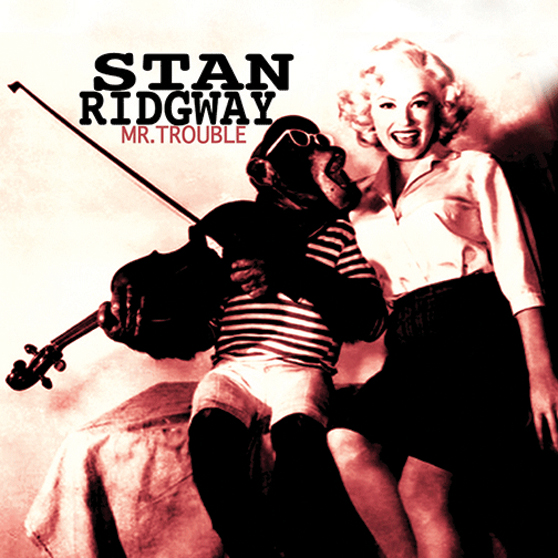
Track List: 1. The Drowning Man 2. All Too Much 3. Across The Border 4. Gone Deep Underground 5. Mr. Trouble 6. We Never Close 7. Afghan Forklift (live) 8. Turn A Blind Eye (live) 9. Stranded (live) 10. Camouflage (live)
Musicians: Stan Ridgway: electric and acoustic guitars, harmonica, keyboards, electronics, vocals / Pietra Wexstun: keyboards, electronics, optigon, farfisa organ, vocals, melodica / Rick King: electric and acoustic guitar, bottleneck guitar, elec. bass / Bruce Zelesnik: drums, electronics, tympani, metal breakdrums, percussion / Ralph Carney: saxophones and woodwinds, trumpet / Enrico Deiro: accordion / Lazlo Vickers: violin, viola / Tommy Arizona: pedal steel guitar / Bill Blatt: acoustic bass.
Produced by Ridgway / Wexstun / Zelesnik and recorded and mixed at Impala Studios, Venice CA. Feb - March 2012.
Album Reviews: Mr. Trouble / Stan Ridgway / A440 Records
Stan Ridgway
|
|
"The first Mr. Trouble tunes that really grabbed me were the bluesy, funky, crime-jazz-tinted numbers, which hark back to Ridgway's early solo years in the mid-'80s — when critics were calling him a rock 'n' roll Raymond Chandler.
"All Too Much" (no, not The Beatles' song) is a breezy, soul-informed workout — there's a horn section! — in which Wexstun and guitarist Rick King shine. The melody might remind you of The B-52s' "Love Shack," but the lyrics aren't so idyllic. Ridgway, as he's known to do, sings about corruption, injustice, and hard times.
|
"Well it's a hot afternoon on a city street/A cop in black and strolling his beat/He hears a baby crying from a window ledge/Times are tough and people still on the edge/And there's a gang of boys movin' on the corner/lookin' mean and gettin' ready to fight/As somewhere downtown in a high-rise office a man at the bank tells you times are tight."
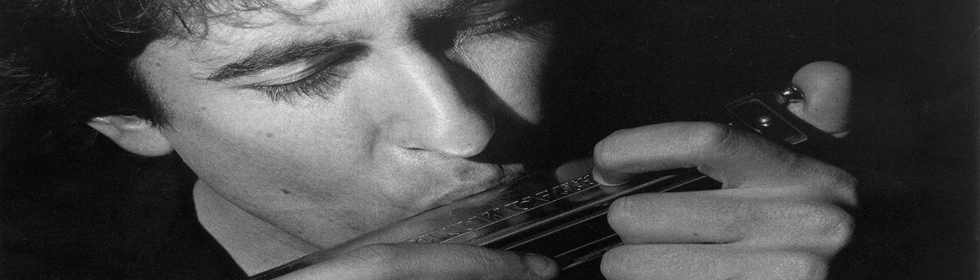
The title song is a swampy blues number that allows King to show off some nasty Tony Joe White licks and Ridgway to blow his distinctive harmonica. What's that strange sitar sound you hear in the background in the first minute or so of the song? Even better is "Gone Deep Underground," a snappy, bass-driven sleaze-blues jumper in which Ridgway sings about institutions crumbling and various people making themselves scarce. The song is full of images of boarded-up houses, people sleeping in airport bars, and even a secret government laboratory. It also contains some of the funniest lyrics I've heard lately: "Sandstorm blowin' into Phoenix can ruin a perfectly good toupee/Hey, somebody hand me a Kleenex/She's on a crying jag that won't go away."
| "Across the Border" might just be the prettiest and saddest song Ridgway's ever written. It's a wistful tune colored by what sounds like tropical marimbas. The melody is gorgeous, and I don't think Ridgway's voice has ever sounded better. But it's the story he tells that will punch you in the gut. A woman carrying only a small suitcase and a cellphone is leaving her country, crossing the border to start a new life. As she's walking, she gets a call from her husband or boyfriend, I assume, who's trying to change her mind. But it doesn't work. |
|

Stan Ridgway
|
"This country, it once was a jewel/In a wilderness so wild and so cruel/But now no one can fix it, everything's broken/So I'm leavin' tonight in this rain/And nothing can stop me, no chain/And least of all you, so don't call me again,' and she closed up her phone." And then comes an unforgettable image. "She walked ahead slowly, her hands holding tight/A boy on the corner lost the string of his kite/And it blew past the red, white, and blue and into the gold, red, and green/Across the border."
At first I assumed the protagonist is a Mexican, leaving her "broken" country to come to the good old U.S.A. But could it be that she's an American going into Mexico? After all, the boy's kite is apparently flying across the border into Mexico, so that's the way the wind is blowing." - Steve Terrell's Tuneup / Santa Fe New Mexican 5 *****
---------------------------
"Just The Drowning Man and Mr. Trouble alone are worth the ride. The interplay of the Violin by Lazlo Vickers and Saxophone of Ralph Carney on The Drowning Man are pure genius. I suppose this is a rhetorical song as I don't believe any one has the answers to the questions Mr. Ridgway poses. Juxtapose the tenderness of The Drowning Man with the gritty driving blues of Mr. Trouble and you have the quintessential Ridgway. Gone Deep Underground is a snappy foot tapper with some neat keyboards by Pietra Wexstun. Before Stan goes into the 4 live tracks, he closes with We Never Close and you see Stan's well is far from dried up. The live tracks will give the uninitiated a good sense of what Stan and his fantastic band sound like live. The musicianship and song writing on this release are superb" - Amazon.com / Pete Kohut 5 stars * * * * *
-----------------------------
Continuing the Ridgway renaissance that started with the insanely creative, beautifully written, tightly produced Neon Mirage and the wacky road-trip fun of the Two Songs About Rome download, Mr. Trouble is a dandy (last minute expanded to 10 song) four song EP. Things kick off with a vintage Ridgway moody 1940s style orchestrated piece that just as well could have been on The Big Heat. Continuing with the full band sound, Stan slips into a full funk form with a tight backing horn section and a dancing upfront organ with All Too Much. I can't wait to see him perform this fun rollicking commentary on modern life life next time he comes to town. Across The Border is Mexican Radio meets bassa nova as the soft lead character of the tune takes you into their mind as they plan their trip to the other side. On the title cut, Mr. Trouble, Stan breaks out his signature harmonica to open this hauntingly familiar Wall Of Voodoo-esque lyrics in this almost swamp-rock sounding gem. " - The Music Scout / Dan Lewbel 5 Stars * * * * *
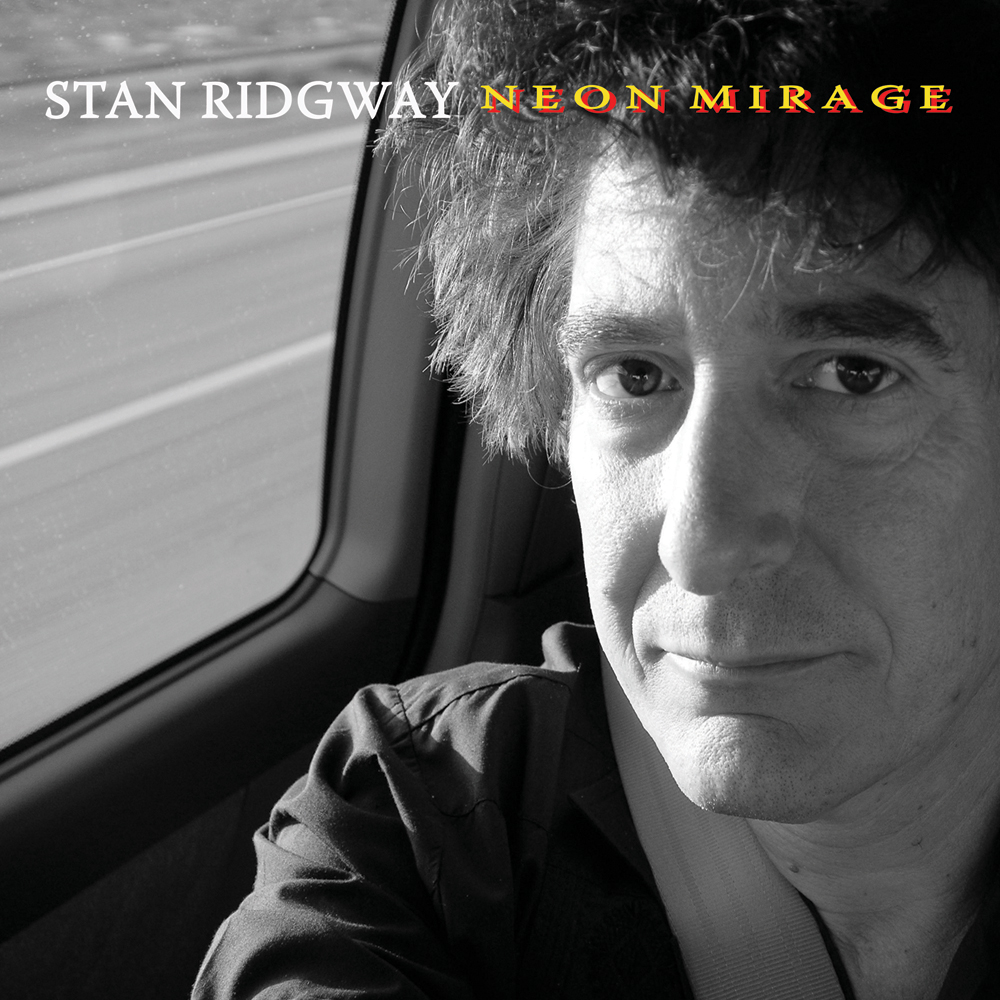
STAN RIDGWAY'S NEW ALBUM NEON MIRAGE,
INFORMED BY LOSS AND LIGHT, IS ARTIST'S MOST
ECLECTIC AND REVEALING
STAN RIDGWAY - "Neon Mirage" - Out Now Everywhere
"Music is more than just chords and notes to me, it has the ability to make pictures in the mind. My records are designed to be seen as well as heard." -- Stan Ridgway
|
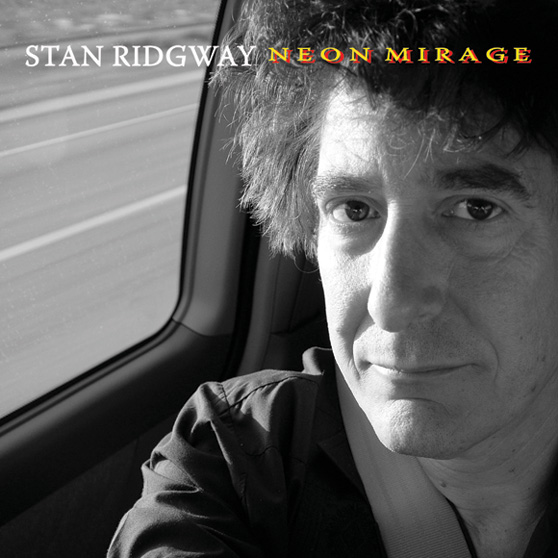
Stan Ridgway - Neon Mirage
|
Does a songwriter chase his muse – or is it the other way 'round? That's but one of the intriguing notions at the heart of Stan Ridgway's 2010 release, Neon Mirage, arguably the most refined, yet musically eclectic collection of the veteran L.A. singer-songwriter/Wall of Voodoo founder's career. "You never really have a choice about the tone and subject matter of the records you make," Ridgway confides. "At least I don't. They're obsessions, really. It's about the music, and how it heals the mind." When Stan lost a beloved uncle, a colleague (Texas violinist Amy Farris, whose brilliant Neon Mirage work serves as fitting elegy), and the man who inspired so much of the musician's own worldview, his own father, during the album's writing/recording, Ridgway responded with some of the most reflective – if no less joyous – songs he'd ever recorded. "Events like that can't help but have an impact on the music you're making at the time," Stan admits. "You'd be lying to yourself -- and your listeners -- if you thought otherwise. I've probably confused people with my music, my choices, the albums and the changes in direction from year to year. But I can't help it. There's a weird old American jukebox in my head and it still plays everything that's ever got under my skin."
STAN RIDGWAY / "NEON MIRAGE" / A440 Records
"Neon Mirage is a winning combination of grit and grease, a buffer and a salve. A clear vision by an artist who's focused, complex and sincere." HERALD EXAMINER
"Mortality and the absurdity of human existence are among the thematic strands running through Ridgway's new Neon Mirage, a dazzling effort that takes its place among autumnal efforts by Zevon, Krisofferson and Dylan. A stately grappling with identity and meaning." UK UNCUT
"Electronic music, film scores, big-band covers, country-inspired excursions - no question, Ridgway is a restless creative spirit." WASHINGTON POST
Stan Ridgway is a true original. One of the most unique singer/songwriters in American music, from his early days with L.A.'s Wall Of Voodoo, to his even more intriguing solo career, Ridgway continues to create an impressive body of work.
2011 brings his new solo album "Neon Mirage" out on tour and new work will be highlighted in addition to songs from his deep catalog of past classic solo albums and Wall Of Voodoo favorites. A celebration in song, story and spoken word.
"Music is more than just chords and notes to me, it has the ability to make pictures in the mind," says noir troubadour and sound alchemist Stan Ridgway. "My records are designed to be seen as well as heard."
Ridgway will be joined on tour with long time co-horts Pietra Wexstun on keyboards, melodica and vocals, and Rick King on guitar, bass and vocals and Bruce Zelesnik on drums and percussion. Expect a thoroughly entertaining evening with one of America's greatest songwriters and storytellers with music from a career stretching from the early 80's to the present.
It's been a long and influential road for the songwriter/guitarist and original Wall Of Voodoo vocalist. His darkly humorous, and richly cinematic musical tales of the ironies inside the American Dream have been compared to other classic songwriting iconoclasts like Randy Newman, Tom Waits, Johnny Cash and even hard boiled mystery writers like Raymond Chandler and Jim Thompson, as well as twisted film makers like David Lynch and Quentin Tarantino. The San Francisco Chronicle said, "He conjures "Burroughs, Bukowski and Brecht," while LA Weekly has called him "the Nathaniel West of rock."
Neon Mirage is Ridgway's latest solo recording from the A440 Music Group and is his eleventh solo album.
Over the years, Ridgway has performed live on stage with: The Cramps, Brian Wilson, U2, Devo, The Pixies, Van Dyke Parks, The Residents, Dave Alvin, Pere Ubu, Peter Case, Bill Frisell, Los Lobos, Ry Cooder, Colin Hay, The Stranglers, The Handsome Family, XTC, The English Beat, Psychedelic Furs, The Clash, The Go Go's, Rickie Lee Jones, Sam The Sham, Johnny Thunders, and many others.
A mad scientist of sound and vision, Ridgway possesses a style unparalleled, at least in our known universe. Making his musical pictures for 30 years now, the singer-songwriter and guitarist has emerged as a singular voice in contemporary song. "It's a hybrid of all the music I've loved and admired," he says. "There are no boundaries on art and no rules to follow in music. A song is really just a strong point of view."
Ridgway works in his own unique form of aural and sonic tradition, chronicling all that lies beneath the safe and sane surface. He craftily sets his dark materials to off-kilter and eerie melodies that echo the uneasy action of a cast of characters on the brink. His tales often take place in the microcosmic miasma of L.A. and its outer desert, where his creations try to wrest meaning from the beautiful catastrophe of their lives. The combination makes for a stunning stew of universal provocations.
"Mystery and irony are attractive to me but that said, I have no problem with entertainment," he says. "Orson Welles was a magician as well as a Shakespearean actor. There's a certain brilliance to that."
Ridgway has soaked himself in European soundtrack music, American folk tradition, primitive rock 'n' roll, blues, psychedelia, free jazz and all that is avant-garde. All of it has seeped into his musical vocabulary. "Life is absurd. But that doesn't mean it has to be meaningless," he says. "Froan early age music centered me in a chaotic world that didn't make sense."
Ridgway's uncanny ability for brushing Old World charm against contemporary disturbances and oddities just might define the disjointed landscape of 21st century life. "I've always liked tall tales, urban myths and ghost stories," he says. "I like a strong protagonist, as well as a story that unfolds with drama, color and detail. A song should take you away for awhile and into another world." Sounds like the definition of a Stan Ridgway song…
Raised in L.A., Ridgway began his love affair with Southwestern gothic 30 years ago as front man and co-founder of vanguard electro-art punks Wall of Voodoo, who he originally formed with the intention of scoring low-budget horror films. Ridgway sang on the band's debut EP and first two albums, Dark Continent and Call of the West (which included the accidental MTV hit "Mexican Radio"). "I sometimes use songs as a way to figure out the puzzle of how things fit or don't. When the balance is right, what the listener brings to it is just as important as what I bring to it," he says.
Pulling numbers from his own revolutionary past and moving into his own honed, sardonic style of present, Ridgway will be accompanied at the shows by Pietra Wexstun on keyboards, electronics and vocals; Rick King on guitar, bass and vocals. Wexstun and Ridgway have lived and worked in tandem for more than 30 years; her keyboard and vocal sounds are perfectly in tune with his not-so-typical stories of proverbial American tragedy and triumph.
"I've always thought of songs like films in the mind really, except I'm the actor and the director, the lighting and prop person and DP too. When it's working, you should be able to see the song as well as hear it."
Ridgway is a rare performer and songmaker whose enduring sketches nail the human condition down cold while his characterizations of life remain absolutely fresh and alive. The primal urges that drive his creations--whether they're searching for a home in "Underneath the Big Green Tree," or acknowledging our collective heritage in his electronic reworking of Johnny Cash's "Ring of Fire"-- see Ridgway finding humanity in all stripes, as he celebrates the circus of our lives.
Ridgway's flair for concise character portraits was first noted by uber critic Greil Marcus, who called The Big Heat "probably the most compelling portrait of American social life to appear on a rock 'n' roll record since Bruce Springsteen's Nebraska." Author Mikal Gilmore said it was "the best L.A.-founded record of that year." Ridgway followed with the existential-humanist Mosquitoes (featuring the anthemic "Mission in Life," and the Euro-hit, "Calling Out to Carol"). Partyball (1991) explored the outer-limits of Ridgway's unique world, while 2002's Black Diamond was a more Spartan and personal statement on love and loss.
"At the end of the day I really consider myself just an inventor, or like a link in a chain to a tradition of song and art," the artist says. Music and songs and recording are an obsession for me — sound and art. It's all in there, the ideas and things that influenced me. To see it and tell it your own way is the challenge. That's the last true, honest place to be. It might even be the new frontier right now."
• • • • •
Here's what critics are saying about Stan Ridgway:
Ridgway's post-Wall of Voodoo output has, if anything, cemented his neo-noir rep as one of American music's greatest storytellers, the wild and wily Steinbeck of sad whiskey railroads and rusted, ramshackle American dreams." AUSTIN CHRONICLE
"Neon Mirage, is arguably the most emotionally revealing, musically far-ranging album of the L.A. singer-songwriter's accomplished career." AMAZON
"Listening to Stan Ridgway is always like a musical voyage. As he sings about "your presence in the sand" there's no wonder you'll see a Neon Mirage in the distance. With help from Dave Alvin, Pietra Wexstun, Ralph Carney, Rick King and the late Amy Farris, every lick, note and lyric is post-futuristic and brings to mind the world we're busy ripping apart now. Neon Mirage is without a doubt, Ridgway's strongest effort in years, and one that finds him saddled up and ready to ride with a world-wise bent into the sunset of the unknown - mirage or not. Challenging, interesting, and always highly entertaining. This particular well is long from drying up." ELMORE
"Ridgway's work is always passionate and completely compelling and Neon Mirage is no exception...Stan Ridgway at his quixotic best, telling jagged tales of modern life gone wrong with a casual urgency and a novelist's eye for detail, all set to a soundtrack that soaks up light in a beautiful darkness like polished ebony." CITY BEAT
"Rueful reflections from one time Wall Of Voodoo singer. Mortality and the absurdity of human existence are among the thematic strands running through Ridgway's new Neon Mirage, a dazzling effort that takes its place among autumnal efforts by Zevon, Krisofferson and Dylan. A stately grappling with identity and meaning." UK UNCUT
"Stan Ridgway's Neon Mirage is arguably the most emotionally revealing, musically far-ranging album of the L.A. singer-songwriter's accomplished career." AMAZON
Probably the most compelling portrait of American social life to appear on a rock 'n' roll record since Bruce Springsteen's Nebraska." "The Big Heat" (1986) Greil Marcus in ART FORUM
"Take some of the nocturnal knowledge inherent to Los Angeles that Jim Morrison so famously tapped, add a bit of Dean Martin's way cool swing-a-ding-ding...and you'd be getting close to the subliminal wow of Stan Ridgway. ..It's a completely stunning work, full of strengths and surprises that even while we've come to expect them from Ridgway, they still ring home here with an inescapable heart.. and the world it describes and lessons it imparts are the kind that are downright prophetic." BENTLEY'S BANDSTAND
Wall of Voodoo leader Stan Ridgway is in a reflective mood on "Neon Mirage" one of the finest outings in his idiosyncratic career. Featuring the outstanding roots rocker Dave Alvin and prized session violinist Amy Farris, Ridgway looks for permanence in a forever-changing world. DETROIT FREE PRESS
"In a career that's found him consistently attempting to defy any and all pop parameters, Stan Ridgway's never faltered when it comes to revealing his more exotic intentions. He showed that inclination early on with Wall Of Voodoo, and subsequently pursued it through the retro jazz affectations, dark cinematic-like musings and scary film scores that have become so intrinsic to his solo ambitions. Neon Mirage shines a new light on Ridgway's inner psyche, while also inviting his listeners to fearlessly peer inside. " BLURT
"It's been over 25 years since Stan Ridgway and L.A.'s seminal Wall of Voodoo released Call of the West, and that calls for a drink. The album's dusty, Barstow-to-Bakersfield, Ross Macdonald-meets-Edward G. Ulmer in a Death Valley Detour to nowheresville title track and grimly optimistic film noir narratives still reverberate across the musical Route 66 Voodoo frontman Stan Ridgway paved, roadkill and all..." Ridgway's post-Wall of Voodoo output has, if anything, cemented his neo-noir rep as one of American music's greatest storytellers, the wild and wily Steinbeck of sad whiskey railroads and rusted, ramshackle American dreams." AUSTIN CHRONICLE
"Singer/songwriter Stan Ridgway's new solo album is a glorious hard-boiled Hollywood road movie for the ears. " THE WIRE
Ridgway has become his own wireless theater. Spanning nearly 30 years in song, master storyteller Ridgway pulls out new and old work to dazzling effect. MUSICMUSE
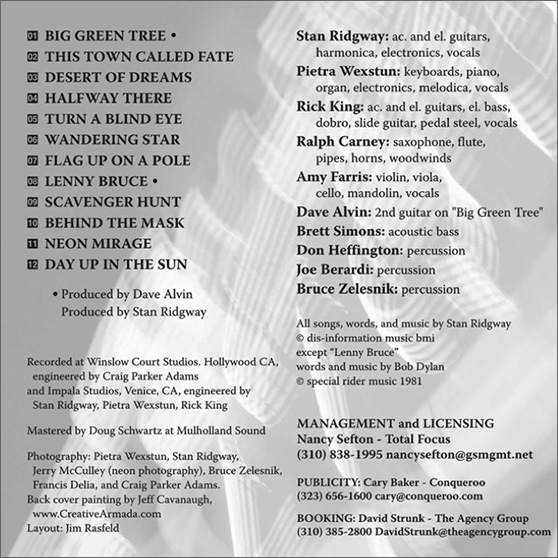
"Stan Ridgway is a brilliant iconoclast with a catalog as strong as that of any more famous songwriter you'd care to name with terrific solo records like Snakebite, Anatomy, The Big Heat, Black Diamond, Partyball and Mosquitoes and more. Thoughtful and mature, the new Neon Mirage is a rich palette of colors, provided by his keyboardist Pietra Wexstun, longtime guitarist Rick King, woodwind maestro Ralph Carney, and the late great Amy Farris on violin and viola. A song cycle inspired as much by loss as by living, Neon Mirage strips his signature sound down to the bare essentials, while still remaining as eclectic as always. The tunes in turn act as windows into Ridgway's soul, a view he's rarely offered before – even if the curtains aren't all the way open...With voyages into territories old and new, Neon Mirage is one of the best albums in Ridgway's long, auspicious career." THE BIG TAKEOVER
"In fact he's an ingenious writer with a grip on low - life imagery that hearkens back to that of Burroughs, Bukowski and Brecht. If a modern American counterpart to Bertol Brecht's collaborations with Kurt Weil exits, it's the music of Stan Ridgway." SAN FRANCISCO CHRONICLE
"Some know him just as the long lost singer with the great Wall Of Voodoo, others as one of the great unsung maverick geniuses of our time." MELODY MAKER
"For Stan Ridgway life is like an old detective movie, full of furtive con men and tough dames who hide their daily crimes in the gray mist of the city. This is mature music, short on sentimentality, long on imagination and style." PEOPLE MAGAZINE
"Stan Ridgway has a cast of thousands at his fingertips, and a wealth of tales in his head. A rare and famous talent. Not part of any club or click, just a maverick in his own right." LONDON MIDWEEK
"Stan Ridgway is one of the most unique and talented songwriters around." RECORD MIRROR
"Haunted by America's pulp serial past, Stan Ridgway has become his own wireless theater." THE FACE
"Stan Ridgway is equal parts Raymond Chandler and John Huston, Johnny Cash and Rod Serling." NME
"Filtered through his sardonically insightful wit, these stories become engaging not only for the details he includes, but the ones he chooses not to expose as well." THE AUSTIN CHRONICLE
"Stan Ridgway tells stories from the underside of America. It's the dream gone sour; the dream that never even took root. Tales of losers who battle on and play the game their own way, with a glamour-less beauty and a bath of realism... slices of lives that knew the rules have been drawn up 'someplace else'; characters that have to bluff to get by." FOLLOW MUSIC AUSTRALIA
"Fast moving novellas full of dense musical imagery, peopled with characters from a human highway 61 revisited." THE FACE
"More noises from America's lost frontier. His songs tell stories that unfold gradually and trade in old fashioned narrative devices like character and suspense. It's a move at once conservative and daring - but, best of all, it works." ROLLING STONE
"Stan Ridgway is the Nathaniel West of rock." LA WEEKLY
"Ridgway has the talent to hold your attention by telling a tale in the same intense and clear way that rockers like Neil Young and Lou Reed do. A cool Californian commentator with a sense of humor to match his sense of history." Q MAGAZINE
"Ridgway's tales of the sad, soft underbelly of the American Dream are songs of hope petering into resignation, of idealism soured into cynicism; he's a very adult writer operating in an arena more usually home to the naive and infantile." THE INDEPENDENTS
"If David Lynch were a musician, he would be Stan Ridgway. Both look at Leave It To Beaver America and see serial killers lurking beneath its porches. Both can infuse a simple everyday object with weirdness and dread, creating a world that's consistently disturbing, fascinating and cool." L.A. WEEKLY
"Its possible that Ridgway's change of stance reflects a more serious attitude toward his music. Ridgway isn't just a wise guy anymore." L.A. TIMES
|